levees - Essay
What you need to do:
-
Name the landform.
-
Draw a labelled diagram.
-
Give an example.
-
Explain the formation of the landform focusing on the processes of deposition.
-
State what deposition is and why it occurs.
Levees
In this answer processes involved in the formation of river levees will be examined. Levees are landforms formed by the processes of river deposition during flooding.
Irish example: the banks of the River Moy in County Mayo.
The formation of levees
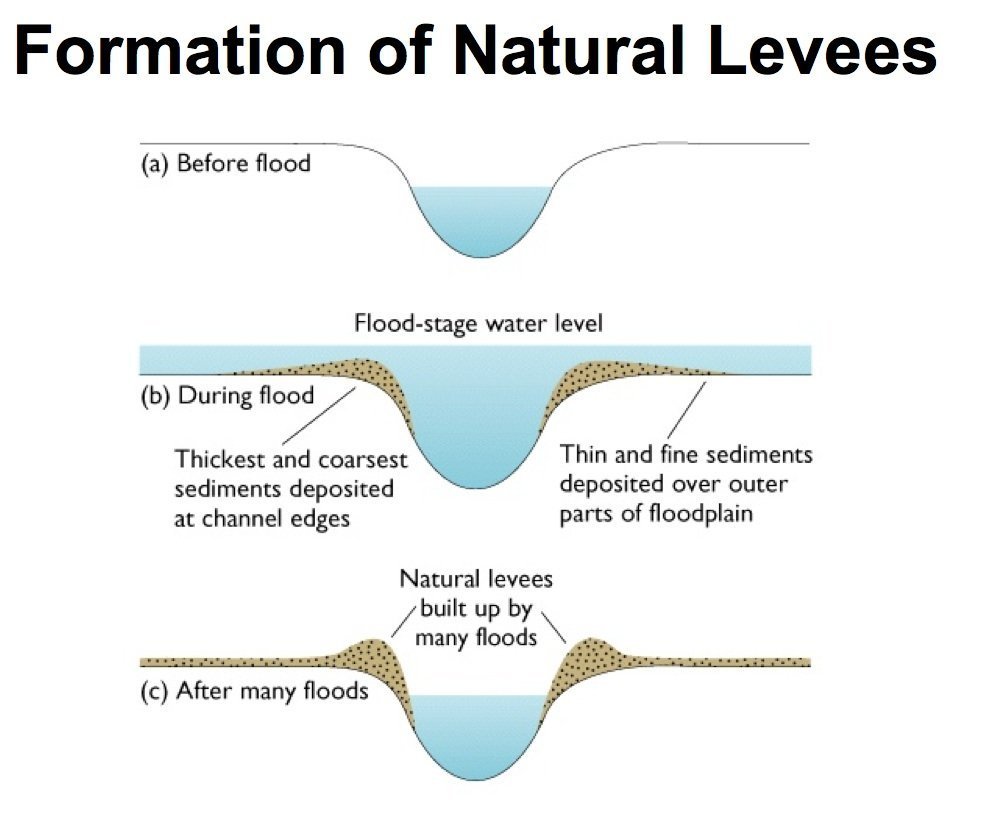
A levee is a wide ridge of sediment on the banks of the river. They are landforms of deposition often found in the lower stage of sediments-laden rivers
River deposition occurs when the river loses energy and can't carry its load. This can happen for a variety of reasons, e.g. the river may slow down when it floods onto its floodplain and suddenly becomes shallower. Levees form because of flooding. During normal flow the river is confined in its channel and deposition will occur on the river bed. However, during the flood event the river overflows its channel and pours over the floodplain.
Once the river has overflowed its channels, it will slow down due to the sudden decrease in debt and the fact that it has escaped its channel and now has a wider area to flow over. The loss of energy causes deposition the heavy stones are deposited first and closest to the banks while finder alluvium is carried further away across the floodplain.
Over repeated blood events the deposit of heavy sediment buildup on the banks and form ridges called levees. Levees ar a rivers natural defence against flooding. They keep the river within its channel as every time the river floods it will have to rise higher to escape over the levees. Eventually, deposition on the riverbed combined with the natural levee building leads to a situation where the bed of the river channel is above the level of the floodplain and the levees are the only thing preventing it flowing over the floodplain.
When humans reinforce levees or build artificial ones, it can interfere with the rivers natural flood processes and trigger more extreme floods further downstream as has been seen along the rivers Rhine and Mississippi.